Since Windows 10 support has recently ended, I think it's a good time to give my thoughts on Linux.
Background
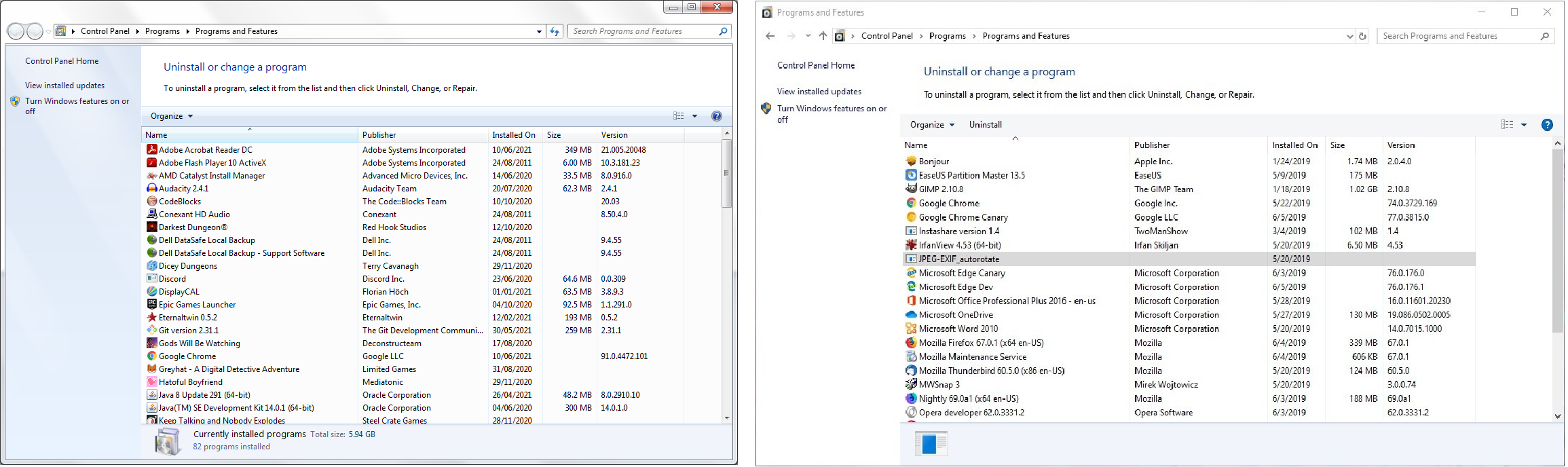
I switched to Ubuntu in June 2023, after an overwhelming amount of programs I used had stopped supporting Windows 7. Among them were Chrome, Steam, NodeJS, and Git Bash, all of which I used daily. I had been holding onto Windows 7 long after mainstream support ended in 2015 and extended support in 2020, mainly for its user interface. It didn't have Cortana, it had a Task Manager and Control Panel I was familiar with, and I much preferred the Aero design. I already had a laptop on Windows 10, so I had firsthand experience of the changes and wasn't fond of switching.
Just look at what they did to the design. The Windows 10 screenshot has no personality at all.1
Making the switch
I already had a few years of experience using the terminal: enough to navigate, write simple bash scripts, and use vim. However, I still had a strong preference for GUIs and using a mouse. Thus, a beginner-friendly distro like Ubuntu seemed like the best fit for me. I spent a few days trying it out using VirtualBox, a virtual machine that emulates another OS and allowed me to experience what using Ubuntu full-time would be like. However, the input lag was quite noticeable and I eventually decided on dual-booting. In this way, I would have Linux directly on the hardware, but if needed I could switch back to Windows for individual tasks.
Unfortunately, having such an old computer came with additional problems. It had a legacy BIOS system whereas newer PCs use UEFI, so I had to finagle the Ubuntu installer to not use UEFI despite every stackoverflow answer being about the opposite. balenaEtcher, a commonly recommended program that would get Ubuntu onto a bootable USB, also stopped supporting Windows 7, so I used Rufus instead and had to ignore some sketchy warning prompts on install. All this would have likely been avoided if I simply had a newer computer, but the rest of the install process was very straightforward.
Configure all the things!
I spent much of the first few days just installing programs and configuring things the way I wanted. Not only are a whole bunch of Windows fonts not installed by default, but even after they're installed, Linux renders them differently. Still, after a while I figured out I needed to get Segoe UI and tweak the font hinting until everything looked approximately right.
Then I jumped into all of the themes and window decoration options. Although it was usable, I felt that GNOME, the default desktop environment, was on the ugly side. I tried very hard to modify how applications looked until I gave up and switched to KDE, which I heard had a more customizable user experience. A few hours later, I had it:
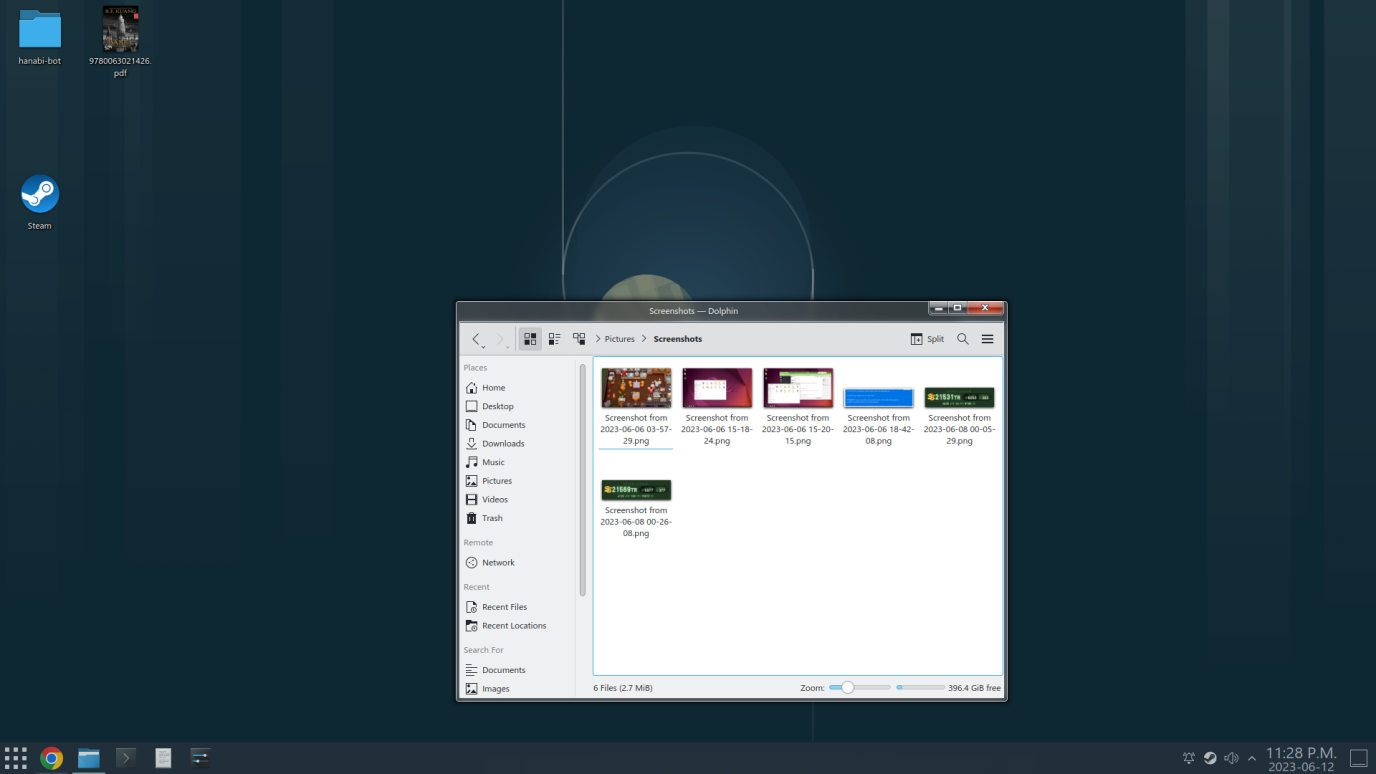
It's not quite Windows 7, but it's pretty close. I won't deny that this was a lot of work, but at least it's the type of work that you do once and then never need to touch again.
I bought a new PC only a few months later in Sept 2023, and went straight for Kubuntu: a flavour of Ubuntu that comes with KDE instead of GNOME. Although it was a bit annoying to have to do all that configuration again, I was much more familiar with all the hoops I needed to jump through. I've done very little additional customization since then.
My Daily Life
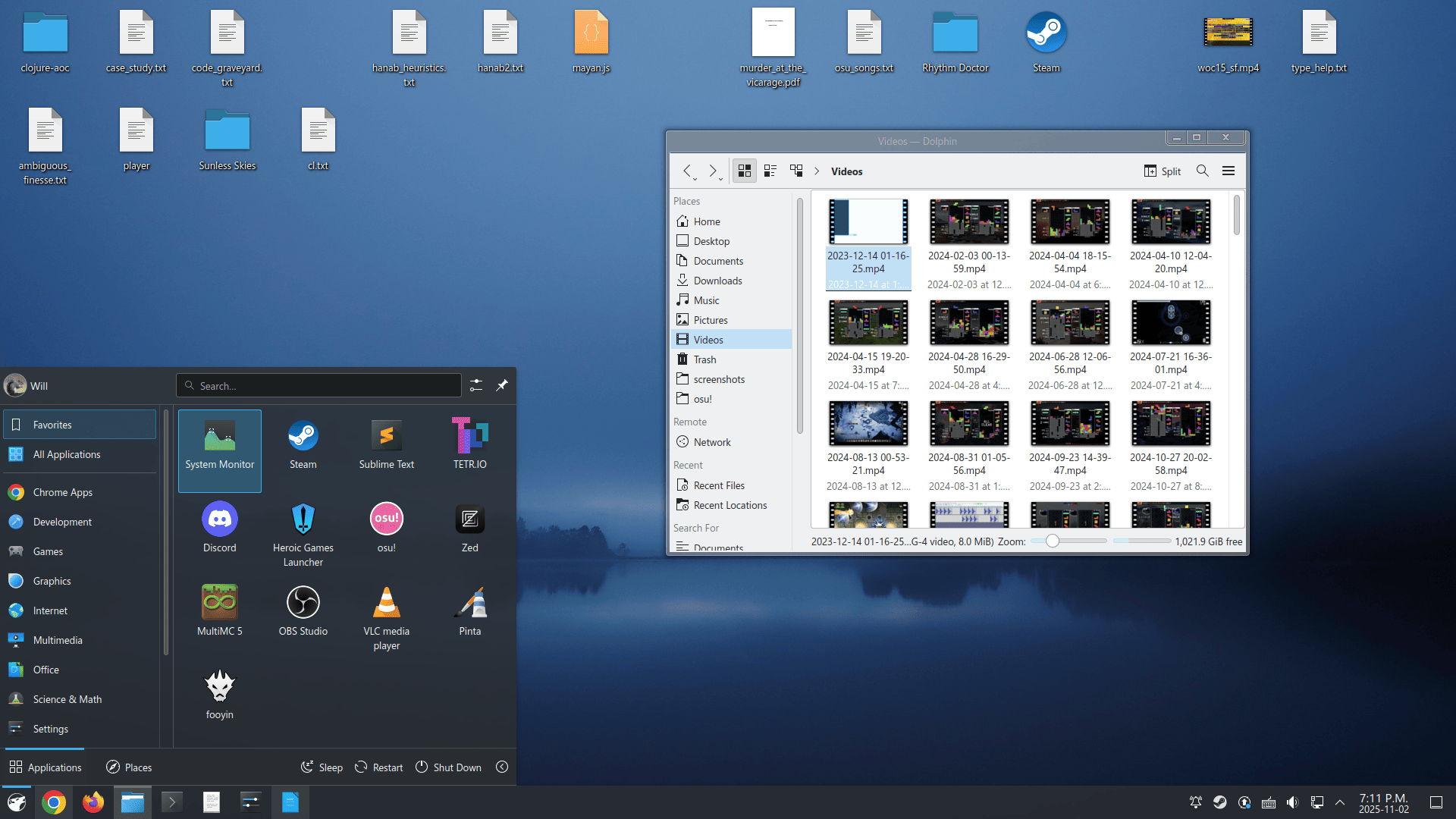
My workflow is practically unchanged from when I was on Windows 7. I'm greeted with a login screen which loads to a desktop, I click all the applications I want to open either from my taskbar or the Start Menu, and I can play osu! or Don't Starve Together with just a click.
A big benefit of the change is that programming is way easier. I have full access to bash (not whatever limited stuff Git Bash has), I can use the AddressSanitizer libraries when compiling C/C++, and programs listen when I want to kill them. Although less of a problem now, my old PC had only 6 GB of RAM, so I often needed to end programs from Task Manager and it was very frustrating when they didn't die.
Gaming on Linux
This is the part I was most worried about (and rightfully so), but gaming has been fine for the most part. You can view how well games run on Proton, which encompasses most games on Steam. I've also played Minecraft, Tetr.io and some games on Epic Games.
There is a slight quirk when installing programs from a .deb: at some point the dependency resolver broke, so instead of being able to double-click the installer, I need to use sudo apt install <file_path>. The only program I regularly need to do this for is Discord because it doesn't auto-update, but I use browser Discord most of the time anyways.
osu!lazer has a native Linux version, but tournaments are still played on osu!stable which is Windows-only. Lots of people recommended using Lutris, but I kept getting black screens and there was a lot of input delay. For a while, I would switch to Windows only to play osu!, but I eventually discovered osu-winello, which has since worked perfectly.
Epic Games seems to be completely against Linux, so you can only download the Windows versions of games, even if the developer has published a native Linux version. Thus, all games on that platform have to be run using WINE or Proton. In fact, the launcher doesn't even have a Linux binary: I have to use Heroic to even access my Epic library. This means that games that have dedicated Linux binaries might actually play worse, which is unbelievable. As Proton is still great, I've still been able to play most games, but there have been quite a few errors I needed to troubleshoot.
Additionally, I've learned to be much more careful with updating software. Once I updated something in the kernel and Tetr.io started running at 10fps, which was very sad. On the bright side, Linux rarely forces you to do updates, unlike Windows, which loves to queue updates automatically in the background.
Overall
Honestly, I think it's pretty hard to tell the difference between Windows 7 and my current setup. I'm very satisfied with my decision to switch, and in classic Linux-user fashion I've been trying to convince everyone who will listen to join me. I do think that having terminal knowledge, doing a lot of programming, and being incredibly particular about the UI are things that won't apply to everyone. I also don't play any games with anti-cheat, Roblox, or extremely old niche games, because I've also heard those have very poor Linux support. But if you're also unhappy with Windows and some of this resonated with you, why not give it a try?
-
Don't even talk to me about Windows 8. ↩